Australia
DOWNUNDER
- IF YOU'VE NEVER BEEN,
YOU'LL NEVER KNOW-
By Paul Dye
Suddenly your torn loose from your comfortable and predictable home life, and sent hurtling through the stratosphere. You're in a 747, crossing first a portion of the north Pacific, and then the south pacific, headed for a far-off exotic land.
It's mid-August, and Lynn and I and our good Marysville friends Dick & Jan are headed for the southernmost Australian state of Tasmania, an island paradise about 500 miles off the southern coast of mainland Australia. It is absolutely beautiful; in fact, while I never thought I'd say this in many ways it matches our own home paradise, here in the northwest. From gorgeous blue bays and sandy beaches, to sparkling mountain lakes full of trout, to lofty snow covered peaks accessible by winding roads from pleasant little cities, it's what my family likes to call an ooh-ahh type of trip.
SYDNEY - ENROUTE
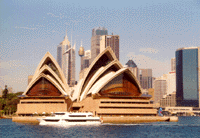
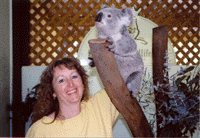
To get to Tasmania we had to change planes in Sydney, so we decided to experience that fair city for a couple of days. While we weren't able to do it justice in so short a time, we found it completely enjoyable. The whole city is in final preparation for the summer olympics, which are just 2 weeks off. The public transportation facilities are excellent, with taxis, buses, monorail, light rail, ferry service and even high speed "rivercat" catamaran service easy and affordable to use. We started with a harbor cruise, with excellent views of the famous Opera House, the Sydney bridge, island fort & parks, a navy base and the harbor shipping facilities. The guides were very informative and the photo-ops terrific. On the second day we took the light rail system out to the Olympic Park, and after a brief look at the facilities, we traveled on to Blacktown, where we hired a cab to take us to Featherdale Wildlife Park. The big thrill for the ladies was to get to cuddle a Koala Bear, and for me to see all the interesting birdlife of Australia. We also had a chance to shop and visit a pub in the famous "rocks" district and enjoyed two wonderful dinners, one at the revolving Sydney tower, that city's tallest building, and the other on the waterfront. At most places, with the Olympics services and facilities in place, but with the attendees not yet arrived, it felt like "the calm before the storm". We were a little relieved to be able to miss the "storm".
TASMANIA - AT LAST
Our flight to Hobart, the capitol city of Tasmania, was on a late model 737. After crossing the Bass Strait, Tasmania came into view. Being lush and green with rolling farmland it looked an awful lot like Ireland from the air. What set it apart were the beautiful coast lines and mountain ranges in the distance. As we neared the southeastern part of the island our excitement mounted as the Darwent River, and then Hobart came into view, nestled along its shore amid rolling countryside covered with farm and forest. After gathering bags and renting a station wagon to accommodate luggage for 4, we made our way into town along good 4 lane highways.
When you have a chance take a look at a world map. Hobart is at the south end of the southernmost state of Australia, the southernmost country in this area of the pacific. Only the Antarctic is beyond, and only South America extends this far south. Considering this, it came as quite a surprise how comfortable and well equipped our hotel was. I was even able to keep in touch with friends and business associates at home and in Alaska by e-mail from a kiosk in the lobby. Since I'm a combination of wildlife and wilderness advocate and technofan I was in my element, with wonderful seafood available to boot.
Within easy driving distance from Hobart are numerous wonders, both manmade and natural. We took in as many as our two days there would allow. The first day we traveled to the Tasman Peninsula to visit the historic Port Arthur Penal Colony and the Tasmanian Devil Wildlife Center. On the way the coastline, with its many inlets and bays was lovely to behold. The ruggedness of this Tasman Sea coastline, and the almost impenetrable nature of the rank vegetation makes it obvious why it was ideal for one of England's early penal colonies.
Port Arthur really makes you sit up and take notice, especially if you're a bit of a history buff. Started in 1830, it housed 1200 convicts at its peak. In 1877, it was the last Australian convict settlement to close its doors. For as minor an infraction as pickpocketing or stealing a pig a London court in those days might sentence the perpetrator to seven or more years at the colony, where no privileges were allowed and strict discipline, including flogging with a cat-o-nine-tails was common. Many convicts just couldn't stand the isolation and cruelty, and suicides were common. It's still possible, even today to stroll through the penitentiary, staff quarters and chapel ruins. A visit to the narrow strip of land that separates the Tasman Peninsula from the Forestier Peninsula is a further testimonial to the barbarism of that early Australian era. Here a line of staked out vicious dogs was used to keep runaway prisoners from making good their escape. It almost always worked.
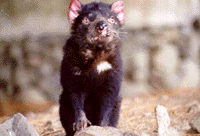
From Port Arthur we made our way to the Tasmanian Devil Wildlife Centre, where we were able to see a number of these unusual carniverous marsupials. Here we were also able to get up-close looks at Wallabies and Pademelons, native Eagles, Tawney Frogmouths and a Brown Falcon, as well as the terrestial Cape Barren Goose and several native Parrot Species. The Centre was established as a wildlife rehabilitation facility, and today continues this work, in addition to its educational functions. A small fee is charged for admission.
After we left the center we were treated to an unexpected thrill; a pair of large Yellow-Tailed Black Cockatoos, each approximately 2 feet in length, landed in a tree immediately in front of our vehicle. These beautiful birds feed on eucalyptus tree bark, pine cones and banksia seed. All along the roads we saw roadkills; mostly Wallabies, Pademelons, Wombats and Tasmanian Devils. We noticed that many of the cars that regularly travel these roads are equipped with special shields to keep these animals from destroying their front end on impact.
When we left Hobart we gradually wound our way northwestward through farmland, then rangeland populated by numerous sheep and cattle, to a more rugged National Forest area that has been declared a world heritage area. This route is identified as The Wild Way. We stopped for lunch at Lake Saint Clair, Australia's deepest lake, and surrounded by jagged peaks. This is a beautiful recreation area, densely forested with giant ferns growing under the rain forest tree canopy in many areas. As we enjoyed our lunch and contemplated our next adventure we watched Wallabies munching on the vegetation just off the front deck. We walked a portion of the lake shore hoping to see a Platypus but without any success. It is truly a beautiful place and the headquarters building, where you pay your entry fee has marvelous displays that teach about the local wildlife species, both terrestrial and aquatic. We were in no hurry to leave, but knew we needed to make it to the west coast where we had a reservation that evening.
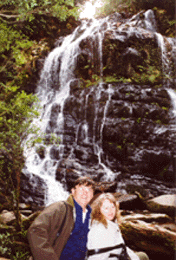
As we made our way west we stopped for a brief walk through well interpreted forest to Nelson waterfall. From there we passed through a large copper mining area centered on Queenstown, and then began our decent to the Southern Ocean coastal village of Strahan.
As we dropped out of the mountains and entered Strahan we were struck with its attractive seaside resort/fishing village atmosphere. It is situated at the north end of peaceful Macquarie Harbor, which connects the scenic Gordon River to the Southern Ocean. Tourism, aquaculture and commercial fishing are obviously its livelyhood, and are appropriate to maintain the quality of the surrounding rain forests and aquatic resources. The Gordon River is a major tourist destination in this part of the world as its pure, but tea colored water drops out of the central highlands, thru wilderness rainforest to the harbor. The wilderness it drains is part of the Franklin/Gordon National Park which has been included in the Tasmanian Wilderness World Heritage Area. A cruise a short way up river provided us the opportunity to see a Platypus and be awed by a 2000 year old Huon Pine tree during a short wilderness walk. We were amazed by the similarity of its rain forests to our own, here in the northwest.
Upon returning downriver we had a photo opportunity at historic Sarah Island, the site of an early and especially brutal early English penal colony. Much of the ruins were removed many years ago, as they were an embarrassment to the Australian government at that time. Enough remains to give the visitor a feeling of the isolation and deprivation that occurred so many long years ago.
From Sarah Island we cruised through the harbor entry, appropriately called Hell's Gate, and out into the Southern Ocean. After a brief search for whales we returned to Macquarie Harbor and Strahan. That evening we went up to a viewpoint above town to photograph an amazing sunset over the Southern Ocean.
Upon leaving Strahan we headed north past the Henty Sand Dunes and through seemingly endless miles of rolling hills covered with both native forest and forest plantations. The comfortable open road was only rarely punctuated by a small mining or farming village. It was during this 3 plus hour drive up the western part of the island that we saw the least wildlife. By early evening we had arrived at Wynard, a small coastal town on the North Coast. That evening we had dinner at a waterfront seafood restaurant that we had all to ourselves due to it being the off-season.
The next morning we headed east along the lovely Bass Strait coastline. There were lots of photo opportunities with numerous seabirds and majestic rock outcroppings framing tidal pools and sandy beaches. Several of these beaches had signs pointing to productive Fairy Penguin viewing sites. Unfortunately we were there during their winter season, the least productive time of year for Penguin viewing. Late in the morning we reached the mighty Tamar River, where we planned to visit several tourist attractions. The first stop was near Rosevears, where we enjoyed Waterbird Haven park and tearoom. Due to our involvement in a similar haven here in the northwest we were taken on a guided tour of the facilities by the managers, after enjoying refreshments in their tearoom.
Our next stop just a short distance down the road was the Strathlynn Vineyard, home of Ninth Island Wines. Here we enjoyed some fine wine and had lunch looking out over the river. (I unfortunately was driving at the time.)
From the vineyard we went a short way to Grindelwald, a Swiss village and resort not unlike a smaller version of our own Leavenworth. Here we shopped and enjoyed their lake full of big trout and Black Swans. By this time we were starting to tire, so we headed for Tasmanias second largest city, Launceston, and our hotel rooms. As we passed through the outskirts we were amazed at how spread out this attractive city is. Although not particulary hard to get around in, you do have to get used to all the one-way streets. Since we had an early flight out the next morning we had an early evening, just walking around the corner for an Australian/Italian pizza.
TIMES UP
After four days and five nights of good company, nice accommodations, and wonderful scenery and adventure it was time to go. With a little trepidation at leaving so pleasant a place we boarded our flight home, via Melbourne and Fiji. Ah, Fiji - but then that's another story. Stay tuned.
|
|
|



